
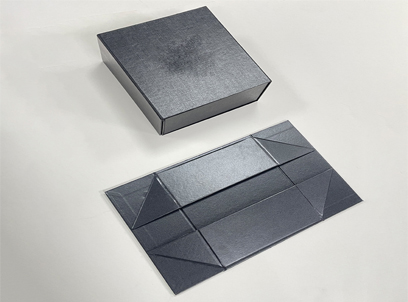
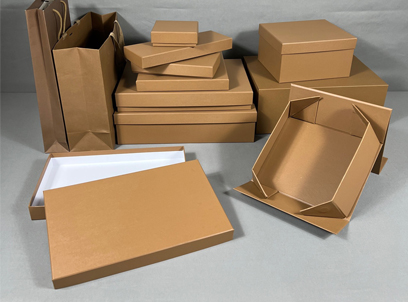
Most packaging quotes stop at the unit price, and that is where the expensive part begins. A rigid box is a hollow cube: once it is formed, most of what you ship is air, and couriers and freight forwarders bill on the greater of actual and dimensional weight. You are not paying to move cardboard — you are paying to move the empty space inside it.
The numbers, measured on a real order
Take a run of 500 rigid boxes. Shipped assembled, they occupy roughly 0.28 m³. The same 500 boxes shipped flat occupy about 0.018 m³ — around fifteen times less volume for the identical finished product. On a real cross-border order this translated into 60–70% less freight cost, and a single container carrying three to four times as many units.
Two savings show up at once. Freight drops, because volume is what sets the bill. And warehouse space drops, because flat stock stacks instead of nesting — which matters more than most buyers expect when a season's packaging arrives months before it is needed.
| 500 boxes | Volume | Freight cost | Container load |
|---|---|---|---|
| Assembled | 0.28 m³ | Baseline | Baseline |
| Flat-packed | 0.018 m³ | 60–70% lower | 3–4 times more |
| Difference | About 15x less | Varies by route | Depends on carton size |
The percentages above come from one cross-border shipment, not a guarantee. Sea freight usually shows a larger saving than air, because container space responds more directly to volume than to weight. We will run the calculation against your actual carton dimensions and route before quoting, rather than quoting a number we cannot stand behind.
One second to form, and no glue
Flat-pack only works if forming it is effortless, so the structure carries the whole design. The box arrives flat and is raised with one movement — a fold and a lift — and it locks through a tongue and mortise joint cut into the board. No glue is applied, no adhesive cures, and nothing needs to be taped.
That has a practical consequence beyond speed. Because there is no glue line, the box can be flattened again for returns, storage or reuse, and there is no adhesive layer mixed into the board when it is eventually recycled. If your market asks about recyclability, this is a structure that answers the question honestly.
What it does not give up
The usual assumption is that a folding structure must feel cheaper, and that is worth addressing directly. Surface finish is unaffected — the box takes coated art paper, textured stock or soft-touch paper in the 350g range, and foil, emboss, deboss and spot UV all run normally. The one rule is that finishing must avoid the fold lines, since foil laid across a crease will crack after repeated forming. We plan the artwork against the crease positions before tooling, not after.
Rigidity is handled through the board specification rather than the structure: 1200g greyboard mounted with 157g duplex board, or 400g laminated to 400g white card. Either gives a wall that holds its edge in the hand. The flat-pack version is marginally less rigid at the corners than a one-piece formed box, which is the honest trade-off — and it is one most gift applications never notice.
Where flat-pack is the wrong choice
Three cases, and it is better to name them than to quote and disappoint later. Drawer boxes cannot be made flat-pack. A drawer needs its sleeve and tray to slide against each other with a set clearance, and that cavity has to exist at the factory; flattening it destroys the fit, and the tray then sticks or rattles. If the pull-out action is what you are selling, this is not the structure.
Very heavy board is the second limit — above roughly 1200g the spring-back on the fold works against the structure and the assembled box ends up less crisp than a conventional one. The third is long-term display: for a box that stands open on a shelf for months, a one-piece rigid box still holds its shape better. For gifting, e-commerce and anything shipped, flat-pack has almost no downside.
Standard specifications
| Item | Standard range | Notes |
|---|---|---|
| Structure | Two-piece, ships flat, one-second form | Tongue and mortise joint, no glue |
| Board | 1200g greyboard + 157g duplex, or 400+400g laminated | Heavier board resists folding |
| Wrap paper | 350g white card / textured / touch paper | Water-based coating replaces lamination |
| Finishes | Foil, emboss, deboss, spot UV | Must avoid fold lines |
| Closure | Friction, or separable magnet (optional) | Magnet removable for recycling |
| MOQ | 500 pcs | Fixed tooling, amortised over the run |
| Bulk lead time | 7–12 working days | Longer when finishes are stacked |
Four things to confirm before ordering
First, send the carton size and shipping method so the volume saving can be calculated on your numbers — the percentage is meaningless without them. Second, decide whether the insert ships with the box or separately, since a fixed insert takes up the space flat-pack is trying to save. Third, confirm that no foil or emboss crosses a fold line; this has to be resolved on the dieline, not on the press. Fourth, be clear about how the box will be used — short-term gifting suits flat-pack almost perfectly, while permanent counter display does not.
Related reading: Volume Weight: How Box Size Sets Freight Cost / Rigid Box vs Folding Carton / EU PPWR & FSC / Box MOQ
<p
Other structures: Rigid Gift Box | Folding Carton | Magnetic Closure Box | Book Style Box
GDF — send your carton dimensions and shipping route, and we will calculate the volume difference before quoting.
Phone/WeChat: +86 15813892599 (Mr. Deng)
www.szgoldy.com