
Choosing a box structure is usually the first real decision in a custom packaging project — and the one that quietly determines your unit cost, your shipping bill and how the product feels in a customer's hands. Most buyers ask us for "a nice box"; what they actually need is a decision between two very different families of structure: the rigid box and the folding carton. They look similar in photos, but they are built differently, priced differently and shipped differently.
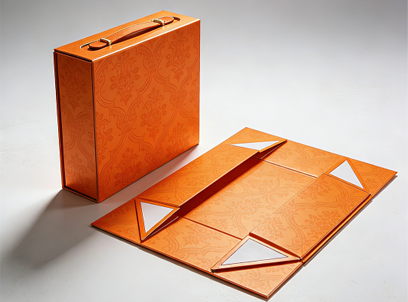

Two structures, two different jobs
A rigid box — sometimes called a setup box — is built from greyboard wrapped in printed paper. The board does not fold; the box arrives fully formed and cannot be flattened. That is why it feels heavy, holds its corners and gives the slow, weighted opening people associate with premium gifting.
A folding carton is made from a single sheet of paperboard, die-cut and creased, then folded and glued. It ships flat and is erected when needed. It is lighter, cheaper per unit at volume, and far more efficient to transport — which is exactly why almost every cosmetic carton on a retail shelf is a folding carton.
Where the cost difference really comes from
The gap is not mainly about paper price. A rigid box costs more because of what happens around the material: the greyboard must be cut, the wrap paper must be printed and laminated, and the assembly is largely hand work. On a folding carton, most of that work happens on press and on a folder-gluer, which is far faster per unit.
That difference also changes how quantity affects price. A rigid box carries more fixed cost into the first few hundred pieces, so moving from 100 to 500 units makes a visible difference to unit price. A folding carton's unit price is dominated by material area and print, so it falls more gradually.
Protection, stacking and the warehouse question
Rigid boxes win on crush resistance. Because the wall is thick greyboard rather than a folded sheet, they stack higher and survive being handled roughly. If your product is fragile, heavy, or will sit in a warehouse for months under other cartons, that matters more than the price difference.
Folding cartons protect well within their design limits, but their strength depends heavily on board weight and how long they are stored. A carton that is fine for eight weeks can lose noticeable rigidity after six months in a humid warehouse. This is why we ask about storage and shipping conditions before quoting board weight — the answer changes the specification.
Shipping volume: the hidden multiplier
This is the part buyers most often miss. A rigid box ships empty and assembled, so you pay to move air. A folding carton ships flat. On a long freight route, that difference can outweigh the per-unit price gap entirely — which is why some buyers who start with a rigid box end up running a folding carton for e-commerce and keeping the rigid version for retail.
| Dimension | Rigid box | Folding carton |
|---|---|---|
| Structure | Greyboard wrapped in paper, arrives formed | Single sheet, die-cut, folded and glued |
| Ships as | Assembled, cannot be flattened | Flat, erected at packing |
| Unit cost | Higher, more hand assembly | Lower, press and gluer driven |
| Crush resistance | Strong, stacks well for long storage | Adequate, declines with time and humidity |
| Freight volume | High, you ship empty space | Low, flat packing saves volume |
| Best for | Gifting, premium retail, fragile goods | Cosmetics, food, e-commerce, volume runs |
Printing and finishing behave differently
Both structures accept the same decoration — offset print, hot foil, spot UV, embossing — but they hold it differently. On a rigid box, the wrap paper is usually laminated before wrapping, which flattens the surface and lets foil and embossing sit very cleanly. On a folding carton, decoration is applied directly to the board, so heavy embossing near a crease can crack and thick UV over a fold line is a known failure point.
A practical rule we give buyers: if your design depends on deep texture or a heavy metallic effect, a rigid box carries it better. If your design is mostly colour, photography and clean typography, a folding carton will look just as good for less money.
MOQ and lead time
Folding cartons usually start lower and run faster once approved, because the process is almost entirely on press. Rigid boxes need board cutting, wrapping and assembly stages, and a meaningful part of that is manual, so lead times are longer and very small runs are less efficient.
At GDF both structures start at 500 pieces. Below that, the fixed costs — die-cut tooling, plate making, press setup — dominate the quote so heavily that unit price stops making sense for the buyer. If you need less, ask us whether an existing tool can be reused; that often removes the tooling cost completely.
Which structure fits your product
| Product type | Recommended | Why |
|---|---|---|
| Serum, cream, lipstick | Folding carton | Retail shelf standard, low freight, fast runs |
| Perfume, watch, jewellery | Rigid box | Weight and opening feel carry the brand value |
| Gift sets, multi-item kits | Rigid box with insert | Holds several items in fixed positions |
| E-commerce skincare | Folding carton + shipper | Flat storage, low dimensional weight |
| Fragile or heavy items | Rigid box + moulded insert | Crush resistance and stacking matter most |
| Promo / seasonal runs | Folding carton | Short life cycle, cost sensitive |
Four things to confirm before you order
First, your product dimensions and weight — everything else follows from these. Second, how the box will be shipped and stored, because that decides board weight and whether a folding carton will hold up. Third, your target unit cost and quantity, since the two structures respond very differently to volume. Fourth, which surface effects are essential to the design and which are optional, so we can put your budget where it shows.
Send those four and we can usually tell you within a day which structure is the better fit — and if the honest answer is the cheaper one, we will say so.
Related reading: Packaging Inserts / Volume Weight / Packaging Quote
Explore structures: Folding gift boxes · Cosmetic boxes
Shenzhen GDF Printing Manufactory Co.,Ltd.
Email: 251547865@qq.com
Phone / WeChat:: +86 15813892599