
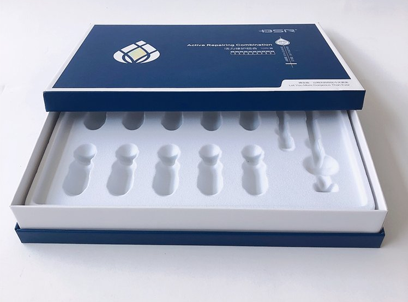
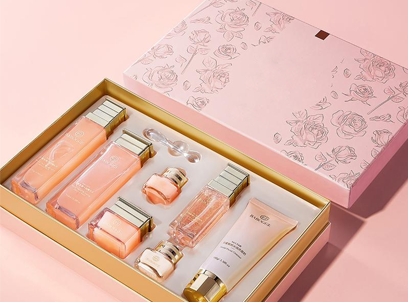
Cosmetic packaging is the most demanding category in custom boxes. SKUs multiply, formulas get reformulated, and launch windows are measured in weeks — yet the box is still expected to photograph beautifully and open with a sense of occasion. When packaging slips, the marketing calendar slips with it. When a bottle arrives broken, you lose far more than one unit; you lose the reorder.
This page sets out how we configure cosmetic boxes: choosing among the three standard setups, typical sizes and board weights, the five box styles that actually work in this category, how to spec inserts so bottles survive transit, how to build visual depth on a limited budget, and the four pieces of information we need before we can quote. If this is your first project, look at the beauty rigid box case first for a visual reference, then come back to the numbers.
Start Here: Three Packaging Configurations
Most cosmetic projects fall into one of three setups: folding carton, rigid box, or a gift set that combines both. The difference is not "which one looks more premium" — it comes down to your sales channel, your order quantity, and whether the unboxing moment needs to carry weight.
A folding carton uses 250–350gsm white card or coated art paper, ships flat and is assembled at your end. It is the lowest unit cost and the lightest on warehouse space, which suits single products sold through e-commerce and retail shelves. A rigid box wraps greyboard in specialty paper, ships already formed, and carries real weight in the hand — the standard choice for gift sets and premium lines. A gift set uses folding cartons as inner boxes to hold individual items inside an outer rigid box, balancing cost against presentation. It is the most common solution for multi-piece holiday sets.
| Item | Folding Carton | Rigid Box | Gift Set |
|---|---|---|---|
| Typical material | 250–350gsm white card / art paper | 1000–1500gsm greyboard wrapped in specialty paper | Outer rigid box + inner folding cartons |
| How it ships | Flat, assembled on site | Pre-formed, ready to pack | Pre-formed, ready to pack |
| Unit cost | Lowest | Higher | Mid-range |
| Compression & drop resistance | Relies on the insert for reinforcement | Strong box structure by itself | Double protection |
| Best for | Single items, e-commerce parcels, retail shelves | Gift packs, sets, premium lines | Multi-piece sets, seasonal gift boxes |
| Storage footprint | Smallest | Larger (non-collapsible) | Larger |
Typical Sizes and Board Weights
The dimensions below are working ranges drawn from common product types, not standard sizes — your actual bottle is the reference. The single most common mistake in cosmetic packaging is sizing from a drawing instead of from the physical bottle, which is how you end up with inserts that do not grip or lids that will not close.
| Product type | Common size (L × W × H) | Suggested material |
|---|---|---|
| Serum / ampoule | approx. 45 × 45 × 120 mm (30 ml bottle) | Carton: 300gsm white card; rigid: 1200gsm greyboard |
| Face cream / eye cream | approx. 70 × 70 × 70 mm (30–50 g jar) | Carton: 350gsm white card; rigid: 1200–1500gsm greyboard |
| Lipstick / lip glaze | approx. 30 × 30 × 95 mm (slim format) | Carton: 250–300gsm white card; an insert is essential |
| Eyeshadow / powder palette | approx. 120 × 90 × 20 mm (flat format) | Carton: 350gsm white card; EVA or blister insert to protect the mirror |
| Perfume | measure the actual bottle; irregular shapes are common | Rigid: 1500gsm greyboard with die-cut EVA; drop protection first |
| Sheet mask | approx. 180 × 130 × 40 mm (pouch or sachet) | Carton: 300gsm white card; insert usually not required |
| Skincare set | determined after laying out the item count | Rigid: 1200–1500gsm greyboard with paperboard dividers |
Five Proven Box Styles
These five styles account for most cosmetic work. The first two belong to the folding carton family — they ship flat and cost less. The remaining three are rigid boxes built for ceremony. The deciding factor is rarely "which looks best"; it is whether the customer can get the product out easily. A lipstick in a lid-and-base box forces the user to dig for it every time, and that small friction lands on your brand.
| Box style | Best for | Key characteristics |
|---|---|---|
| Tuck-end carton | Serum, cream, masks and other single items | Simplest structure, lowest cost; the workhorse of e-commerce shipping |
| Auto-lock bottom carton | Heavier bottles, multi-piece sets | Self-locking base carries more weight; faster to assemble than a tuck-end |
| Lid and base box | Gift sets, premium single items | Everything visible the moment it opens; large display surface, photographs well |
| Drawer box | Lipstick, palettes, slim bottles | Sliding motion feels deliberate and is easy to use; can be fitted with a pull ribbon |
| Book-style box | Gifting sets, co-branded launches | Opens sideways like a book; inner panels carry brand story — the strongest storyteller of the five |
Inserts: Where Cosmetic Boxes Most Often Go Wrong
Cosmetic products come in awkward shapes, mixed materials and fragile glass — and they scratch. An insert is not filler; it decides three things: whether the product survives transit, whether the box looks right when opened, and whether the customer can actually remove the item. Complaints about broken bottles, rattling on arrival, or products that will not come out almost always trace back to the insert, not the box.
| Insert type | Best for | Advantages | Watch out for |
|---|---|---|---|
| Die-cut EVA | Perfume, serum, irregular bottles | Precise fit, strong cushioning, premium feel | Needs tooling; small runs carry the tooling cost per unit |
| Blister (PET / PS) | Palettes, pressed powder, flat items | Transparent, product stays visible, low cost | Feels less premium; confirm material rules for EU shipments |
| Paperboard divider | Sets, multi-piece layouts | Lowest cost; fully paper-based and recyclable | Weak cushioning; not suitable for heavy bottles |
| Moulded pulp | Sustainability lines, export orders | Recyclable and biodegradable; strong sustainability story | Slightly less precise than EVA; coarser surface finish |
| Velvet + foam | Premium perfume, limited editions | Best in-hand feel and presentation; sets off the product | Highest cost; usually assembled by hand |
Finishes: Creating Depth on a Limited Budget
① Get the print right first. In cosmetics, colour accuracy outranks everything else — skin tones, gradients, the sheen on a metal bottle. If the print is off, no finishing technique will rescue it. On small runs, approve a printed sample before committing.
② Do not reach for foil by default. Hot foil stamping requires a metal die, and that die is a fixed cost — the smaller the run, the more it adds per unit. Three foil areas across 500 pieces can cost noticeably more per box than the same design across 5,000.
③ Spot UV plus embossing is the best value combination. UV adds gloss, embossing adds texture, and neither needs separate tooling — both run through the same print process. The cost is modest while the sense of layering is obvious, especially under light.
④ Be careful with lamination. Film gives a mirror finish but hurts paper recyclability. For EU-bound orders we default to water-based varnish, and only apply film locally where a high-gloss effect is genuinely needed — never across the whole surface.
Cost Breakdown: Where the Money Goes
The ranges below reflect typical configurations and will shift with box style and quantity. The point of showing ranges is to make one thing clear: where cost can be cut, and where cutting it visibly downgrades the box.
| Cost item | Share | Notes |
|---|---|---|
| Paper & greyboard | 40%–55% | Board weight is the biggest variable. Moving 250gsm to 350gsm, or a rigid box from 1200gsm to 1500gsm, lifts unit price by a full step. |
| Print & finishing | 18%–28% | Four-colour print is the base; each added spot UV, emboss or foil step increases cost, and foil carries its own die charge. |
| Inserts | 8%–15% | Paperboard dividers are cheapest, EVA and blister sit in the middle, velvet and foam cost most. EVA and blister involve tooling. |
| Fixed charges | 10%–20% on small runs | Plate-making, die-cut tooling and sampling. These spread thinner as quantity rises — the main reason 500 pieces cost more per unit than 5,000. |
| Assembly & QC | 10%–18% | Rigid boxes are largely hand-wrapped and assembled; the more steps, the higher the share. Includes piece-by-piece inspection. |
Specifications and Lead Time
| Item | Standard option |
|---|---|
| Minimum order | 500 pcs (lower is possible for folding cartons; rigid boxes assessed by finishing complexity) |
| Sampling | White dummy sample within 24 hours to confirm size and structure; printed sample in 3–5 days to confirm colour and finish |
| Production lead time | 7–12 days (allow the upper end when several finishes are combined or insert tooling is required) |
| Inserts | Paperboard divider / moulded pulp / blister / die-cut EVA, specified to bottle shape and cushioning need |
| Surface treatment | Water-based varnish by default, keeping the box fully paper-based and recyclable; film applied locally only where a mirror effect is required |
| Label compliance | Print content is supplied by the brand, which is responsible for checking it against local registration rules; we print to the approved artwork |
| Process | Brief → proposal → white sample → printed sample → sample sign-off → production → QC and dispatch |
Four Things to Prepare Before Ordering
① Actual bottle dimensions or samples: body diameter × height, plus whether there is a pump or dropper. This determines both box style and insert — estimated dimensions usually mean rework.
② Product type and channel: e-commerce parcels need crush resistance, retail shelves need display area, gifting needs ceremony. Each of the three leads to a different box and insert.
③ Quantity and reorder pattern: how many in the first run, and whether repeat orders will follow. On small quantities it is usually cheaper to make enough in one go, since a second press run re-incurs the fixed charges.
④ Whether it ships abroad: for the EU, tell us the destination country so materials and finishes can be matched to local recycling requirements — far better than discovering the problem after the goods reach port.
In Closing
Cosmetic boxes rarely fail because the design is unattractive. They fail because the structure and the insert do not match the bottle: a serum in a lid-and-base box that is awkward to lift out, a perfume shipped without cushioning that arrives in pieces, a palette whose insert is too shallow so the mirror arrives scratched. None of these are design problems — they are fit problems. Shenzhen Jindifeng Printing runs its own production line and handles all five proven styles for cosmetic work: tuck-end, auto-lock bottom, lid and base, drawer and book-style. Inserts can be paperboard, blister, die-cut EVA or moulded pulp. Minimum order 500 pcs, white dummy sample in 24 hours, delivery in 7–12 days. Send us your bottle dimensions, item count and target market, and we will come back with a structural proposal before we talk price.
Related cases: Beauty rigid box / Luxury wine gift box / Foldable gift box, flat-packed / Premium electronics box / High-end lid and base box
Related box styles: Magnetic flip-top rigid box / Drawer rigid box / Book-style flip rigid box / Watch lid and base box
Phone/WeChat: +86 15813892599 (Mr. Deng)
E-mail: 251547865@qq.com
https://www.szgoldy.com