
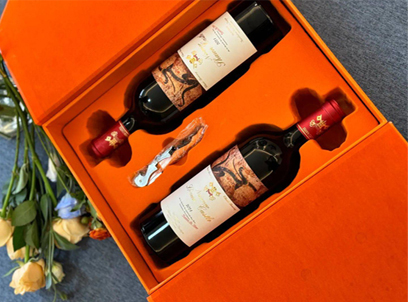
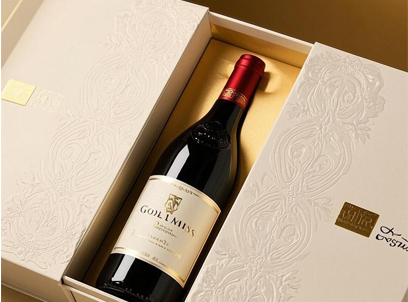
A book style box opens along one spine, the way a hardcover opens, and that single hinge changes what the box can do for a brand. The front becomes one flat, uninterrupted panel — no lid seam running across it, nothing to work the logo around. For packaging that has to stand on a shelf or sit in a photograph, that panel is often the reason this structure gets chosen over a two-piece rigid box.
The spine is where these boxes succeed or fail
Everything else about a book box is familiar; the hinge is the part that varies between suppliers. It carries the whole lid weight every time the box is opened, and it is the first thing to show wear on a sample that gets handled repeatedly in a showroom or a sales meeting. A hinge built from the same wrap paper as the rest of the box will crease and eventually split, because paper folded that many times along one line does not survive it.
The durable options use a reinforced or fabric-backed hinge, or a board spine covered separately so the fold line is not the same sheet as the printed face. These cost a little more and add a step, but they are the difference between a box that still opens cleanly after fifty cycles and one that starts to tear at the corner. If the box is meant to be kept — a keepsake, a document case, a limited edition — the hinge is worth specifying explicitly rather than leaving it to default.
| Hinge type | Construction | Durability | Typical use |
|---|---|---|---|
| Paper hinge | Wrap paper folds at the spine | Creases with repeated opening | Single-use gift packaging |
| Reinforced hinge | Extra layer under the fold line | Good for dozens of cycles | Retail and display boxes |
| Fabric-backed hinge | Cloth tape along the spine | Longest wearing | Keepsake, document, limited edition |
| Separate board spine | Spine wrapped apart from panels | High, with a visible spine band | Premium presentation pieces |
Which side does the product sit on
A book box has a fixed left panel and a moving right panel — or the reverse, depending on which edge the spine sits on — and the insert belongs on the fixed side. Put it on the moving side and the product swings out with the lid every time the box is opened, which looks wrong and, with anything heavy, stresses the hinge. This is obvious once pointed out and surprisingly easy to get wrong on a drawing, because a flat dieline does not show which panel moves.
The fixed panel also takes the deeper well. Because it does not move, it can carry a thicker insert without affecting the closing action, and it keeps the product upright when the box is standing open on a counter — which is exactly how these boxes get photographed.
When to choose this over a two-piece box
A book style box costs slightly more than a two-piece rigid box of the same size, because the hinge adds a step and the spine needs its own allowance. It is worth it when the front panel carries the design — a single large logo, a full-bleed image, a foil block that would otherwise be split by a lid seam. It is also the better choice when the box will be opened in front of a customer: the lid stays attached, so there is no separate piece to put down and no risk of the lid being set aside and lost.
Where it is not the better choice is stacking and shipping. The spine makes the box marginally less rigid along one edge, and a book box does not nest as tightly as a two-piece box in an outer carton. If the priority is pallet efficiency rather than presentation, the two-piece structure still wins.
Standard specifications
| Item | Standard range | Notes |
|---|---|---|
| Structure | Hinged lid, fixed spine on one edge | Left or right opening |
| Greyboard weight | 1000g – 1800g | Heavier board supports the hinge better |
| Hinge | Paper / reinforced / fabric-backed | Specify if the box will be kept |
| Closure | Magnet, ribbon tie or friction | Magnet most common |
| Insert position | Fixed panel, opposite the lid | Never on the moving lid |
| MOQ | 500 pcs | Spine allowance needs its own tool |
| Bulk lead time | 7–12 working days | Fabric hinge adds a manual step |
Four things to confirm before ordering
First, which edge the spine sits on and which panel opens — confirm it on a drawing that shows the motion, not on a flat dieline. Second, whether the box will be kept or discarded after one opening, since that decides the hinge. Third, that the insert is drawn on the fixed panel; if a supplier quotes without asking, the drawing is probably ambiguous. Fourth, how the box closes: a book box without a magnet or tie tends to sit slightly open, and on a retail shelf that gap shows.
Other structures: Rigid Gift Box | Magnetic Closure Box | Drawer Box | Flat-Pack Folding Box
<p
Other structures: Rigid Gift Box | Magnetic Closure Box | Drawer Box
GDF — send the artwork and tell us which edge should open, and we will confirm the hinge before tooling.
Phone/WeChat: +86 15813892599 (Mr. Deng)
www.szgoldy.com