
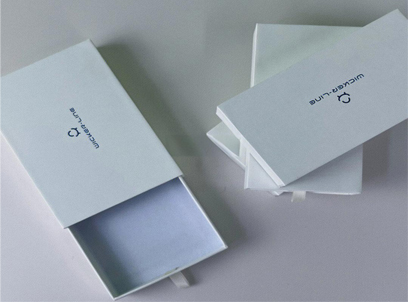
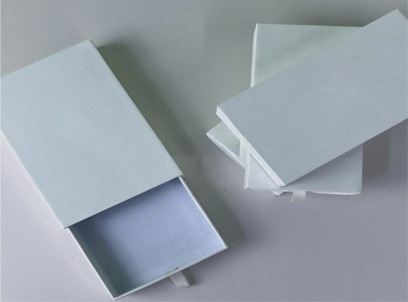
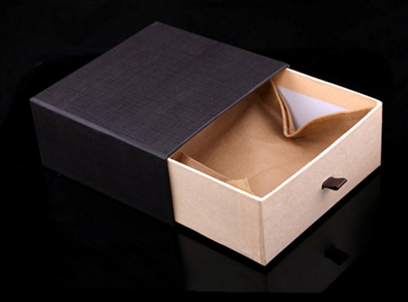
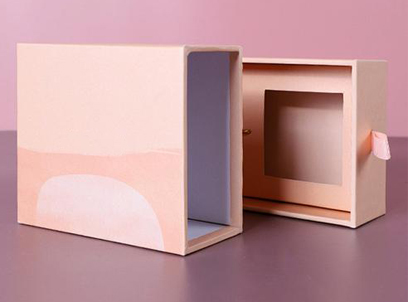
A drawer box turns opening into a sequence instead of an event. The outer sleeve stays on the table and the inner tray slides out, so the product is revealed gradually rather than all at once. That delay is the whole point of the structure — it is why drawer boxes are common for jewellery, watch sets, cosmetic kits and anything sold on the unboxing moment.
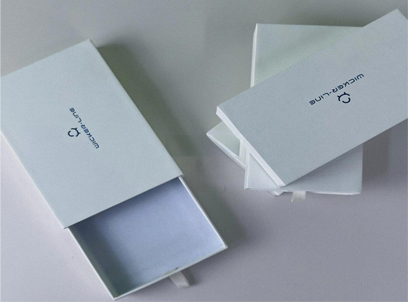
Two ways to open the tray
The tray needs something to pull against, and there are two standard answers. A ribbon pull is a short length of grosgrain or satin fixed to the tray end, which reads as gift packaging and is almost expected in beauty and jewellery. A thumb notch is a semicircular cut in the tray end or the sleeve, which costs nothing extra, survives shipping better than a ribbon, and suits a plainer brand language.
A third option, a finger hole in the sleeve, exposes the tray end directly and gives the firmest grip, but it interrupts the printed face — so it works best on unprinted or foil-only panels. Whichever is used, the pull point should be decided before the dieline is final, because all three change the shape of the tray end panel.
| Opening | How it works | Best for | Trade-off |
|---|---|---|---|
| Ribbon pull | Fabric tab fixed to tray end | Jewellery, beauty, gift sets | Can crush or crease in transit |
| Thumb notch | Semicircle cut in tray end | Everyday retail, electronics | Less tactile than a ribbon |
| Sleeve cut-out | Opening in the sleeve face | Foil-only or unprinted panels | Breaks up printed artwork |
| Full open end | Sleeve shorter than tray | Sample kits, refill packs | Tray visible when closed |
Clearance decides whether it slides or sticks
Every drawer box fails in one of two directions. Too little clearance and the tray jams — the customer pulls, the whole box comes off the table, and the moment is lost. Too much and the tray rattles inside the sleeve, which reads as cheap even when the materials are not. The correct clearance depends on board thickness, wrap paper weight and sleeve length, which is why it is set on a fitted sample rather than calculated in advance.
Humidity moves this number too. Board absorbs moisture and swells slightly, so a tray that slides perfectly in a dry factory can bind in a humid warehouse. GDF builds a small margin into the sleeve for shipments going to tropical or coastal destinations — worth mentioning at quotation stage if the boxes are not being shipped straight to a climate-controlled retailer.
Inserts: the part drawer boxes get wrong
A drawer box has one failure mode no other structure has: the insert can come out with the tray, or worse, stay in the sleeve while the tray slides away from it. This happens when the insert is friction-fit rather than glued or recessed. In a two-piece rigid box the lid lifts straight off and the problem never appears; in a drawer, the sideways motion drags everything loose.
The fix is simple but has to be specified: the insert is glued into the tray, or the tray has a recessed well that the insert drops into. Both mean the insert travels as part of the tray, which is what the customer expects — they pull, the product comes with it.
Standard specifications
| Item | Standard range | Notes |
|---|---|---|
| Structure | Sleeve plus sliding inner tray | Single or double tray available |
| Greyboard weight | 800g – 1500g | Sleeve usually thinner than a rigid lid |
| Opening | Ribbon pull / thumb notch / sleeve cut | Must be set before dieline approval |
| Insert fitment | Glued or recessed into tray | Friction fit alone is not enough |
| Wrap paper | Coated art / textured / soft-touch | Sleeve and tray can differ |
| MOQ | 500 pcs | Two tools needed, sleeve and tray |
| Bulk lead time | 7–12 working days | Ribbon fitting adds a manual step |
Four things to confirm before ordering
First, choose the opening method before the dieline is signed off — it changes the tray end panel and cannot be added afterwards. Second, send the actual product so the insert can be cut to it and glued into the tray, rather than dropped in loose. Third, say where the boxes will be stored and shipped, since humidity affects clearance. Fourth, check the pull action on a fitted sample; a white dummy shows the structure but not the friction, and friction is the one thing customers complain about.
Related reading: Packaging Inserts / Rigid Box vs Folding Carton / White Dummy Sample / Packaging Quote
<p
Other structures: Rigid Gift Box | Magnetic Closure Box | Book Style Box | Flat-Pack Folding Box
GDF — send the product and the pull style you prefer, and we will build the tray around it rather than after it.
Phone/WeChat: +86 15813892599 (Mr. Deng)
www.szgoldy.com